Los Angeles
TTO · FUNNEL TUNING AGENT
Your Funnel is Leaking Revenue
It reveals every funnel leakage layer — including those you prefer not to see
Deploy an individual Funnel Tuning Agent per marketing campaign. It connects fragmented data to form a full funnel, locates leakages and outputs a prioritised action checklist. You retain full decision-making authority. All your choices are recorded for outcome validation in the subsequent cycle.
Built upon a CDP base, TTO is a closed-loop marketing growth OS. Funnel Tuning Agent functions as its engine powering L4 measurement & analytics and L5 closed-loop decision and action cycles.
One campaign, one Agent instance
Action lists default to pending confirmation
No sections for unconnected data sources
Two key notes on this diagnostic
0
unauthorised account changes at delivery
7
tiers of actionable targets down to your web pages
How it delivers funnel tuning
Finding anomalies is simple. Every conclusion supports in-depth follow-up scrutiny
Detecting anomalies is not the challenge; setting threshold alerts is commonplace. The true test is connecting three elements into a fully traceable chain.
If any element is absent, optimisation reverts to ad-hoc intuition. Judgements rooted solely in personal experience cannot be effectively shared between teams or carried across cycles.
If any element is absent, optimisation reverts to ad-hoc intuition. Judgements rooted solely in personal experience cannot be effectively shared between teams or carried across cycles.
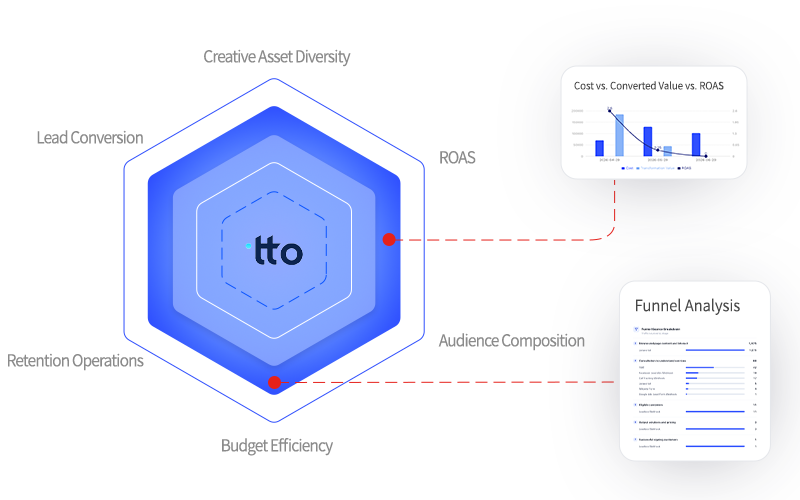
TUNING ① Issue Detection
More than spotting red metrics — a full holistic diagnostic
The real challenge lies in consolidating issues spread across five dashboards into a clear narrative: where the funnel leaks, why the leakage occurs, and which page requires adjustment. These three answers exist in three separate reports. While the data is accessible to all, no one aligns these insights together.
8-Chapter Diagnostic: Core KPIs & Trends, Funnel Leakage Mapping, Spend Structure, Creative & Audience Waste, Landing Page and Lead Capture. Supplementary sections cover Account Health, Action Checklist and Analysis Rationale.
Funnels customised to your business: Both 5-stage and 7-stage frameworks have been field-tested. Endpoints including purchases, booked deals, qualified leads and member engagement are determined by your operations, not fixed templates.
6-Dimension Account Health Scoring: Creative Diversity, ROAS Performance, Audience Composition, Budget Efficiency, Retention Operations and Lead Conversion Experience. Consistent evaluation metrics are applied throughout, making strengths and weaknesses instantly identifiable.
Chapters are omitted for missing data sources: No on-site analytics means no Landing Page & Lead Capture chapter. It acknowledges its blind spots and avoids unfounded assumptions.
TUNING ② Strategy Planning
Data integrity first, optimisation second
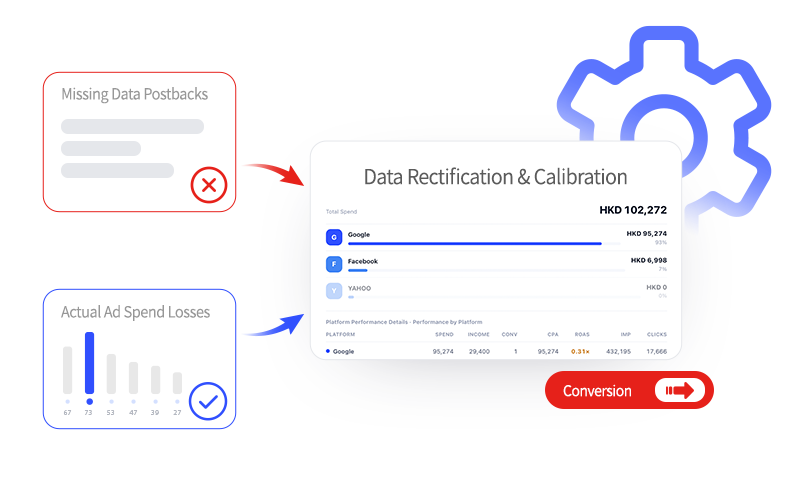
All optimisation choices based on flawed data yield no value. Accordingly, top priorities on the action list are data fixes rather than bid revisions: missing final conversion postbacks, vacant asset group creatives, and backend events disconnected from analytics.
Distinguishing poor performance from inaccurate measurement: A channel showing zero ROAS may stem from wasted spend — or from final conversions never being postbacked in the first place. Two distinct issues require two distinct remedies; conflating them leaves you guessing.
Evidence via experimentation: budget split into test / explore / harvest streams, with pre-defined observation cycles before judgement — no single intuitive bets.
Adjust ratios, not total spend: Reallocate budget first towards channels proven to drive bottom-funnel conversions, before discussing whether to increase overall spend.
Testable forecasts: next-cycle expected ranges and their external dependencies are documented for later reconciliation. Only verifiable predictions have real value.
TUNING ③ Execution Discipline
The auto-execution switch stays in your hands
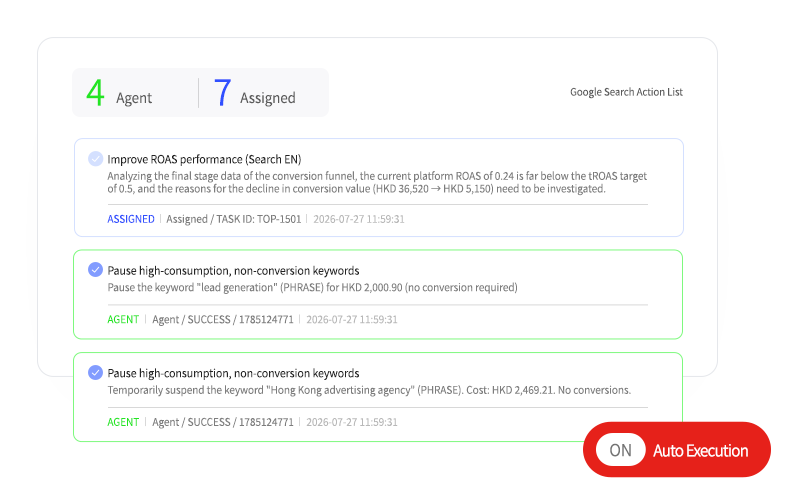
Trust in delegation relies on credible disciplines, not just AI capability. It operates conservatively by default. After account onboarding and before access rights are granted, it audits, prioritises and documents actions with clear reasoning, pending your sign-off.
Human-Agent collaboration features four actionable modes, not rhetoric: Agent auto-execution, tasks routed to Topkee specialists, pending approval, archived. Each action has clear accountability.
Machines manage scalable repetitive workloads: ad-group efficiency analysis, spend reconciliation, cross-referencing on-site activity against funnel stages — volumes beyond human capacity.
Humans retain strategic discretion: creative strategy, total budget, business goals and qualified lead definitions. The system is designed to avoid unilateral automated decisions.
All decisions are recorded in cross-cycle memory: Confirmations, assignments and archives sync to the memory repository. These synchronisations make up 60% of routine commands and serve as the core engine for the system’s self-improvement.
One Tuning Cycle
Complete three steps on a recurring cycle. With each validation, the Agent gains sharper insight into your business versus the prior cycle
This is not a one-time analysis generating a static PDF. It runs aligned with your marketing cycles. All your decisions and validations between cycles feed into the system’s cross-cycle memory
01
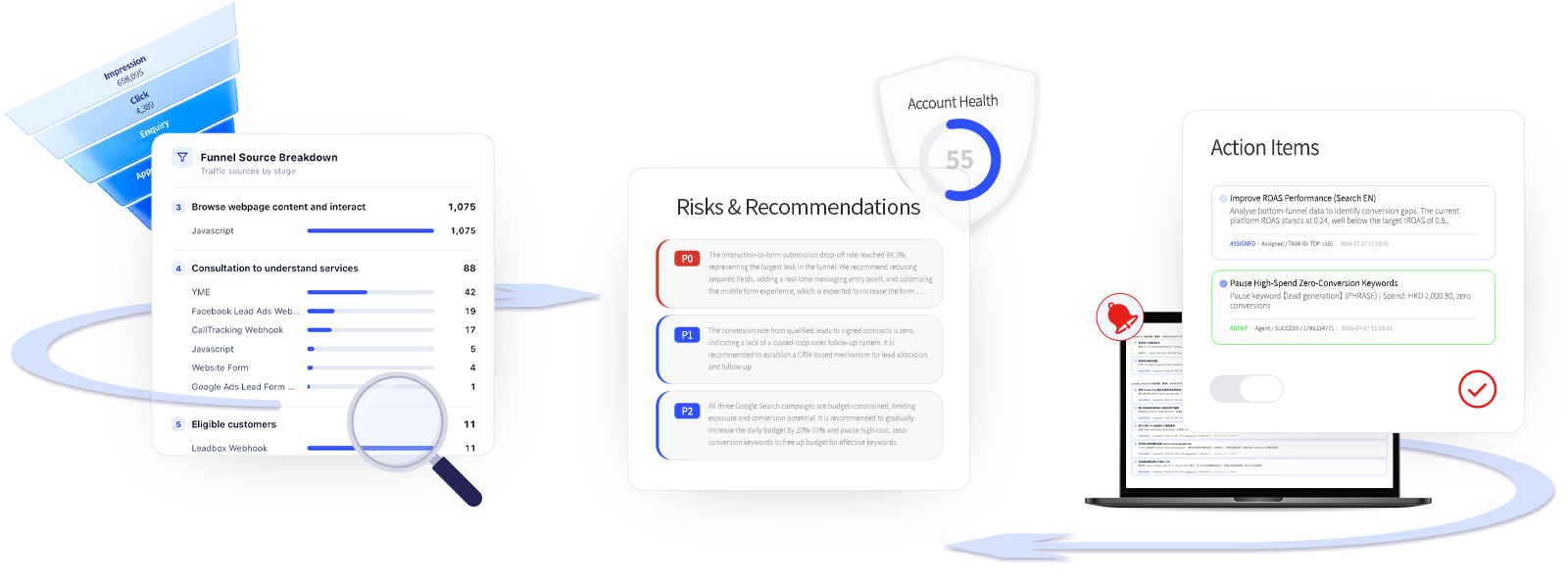
Full funnel visibility down to every detail
It computes pass-through and drop-off rates stage-by-stage according to your defined funnel structure. Rather than a superficial scan of aggregate metrics, the TTO Funnel Tuning Agent maps the full account journey, from front-end traffic to final backend conversions.
Ad platform metrics, on-site behaviour and backend conversion postbacks converge into one unified funnel for diagnostics
Full scan, no sampling. Each data entity is evaluated separately, not just aggregate averages
Locate anomalies to specific funnel stages first, then trace root causes to uncover the real source of problems
Deep Dive Analysis
02
Deliver tiered action items, each backed by tangible evidence
All actions are prioritised P0 / P1 / P2, complete with target tier, object ID and supporting data.
No vague suggestions like “improve landing pages” — only specific directives that stand up to scrutiny.
No vague suggestions like “improve landing pages” — only specific directives that stand up to scrutiny.
Coverage across seven tiers: ads, clicks, web pages, enquiries, qualified leads, quotations and signed deals.
Clear task priorities separate urgent remediation from continuous optimisation, prioritising critical issues.
All suggestions adhere to a four-step workflow: metric reading, anomaly assessment, evidence weighting, action formulation.
Tiered List
03
You make the decisions; the system retains them for automatic validation in the next cycle
All actions — confirm, assign, suspend or archive — are set with a single click within the console. The closed loop completes here, rather than ending when a report is exported.
All decisions feed into cross-cycle memory; every selection syncs to the system memory repository.
The next cycle runs automated checks to validate prior expected ranges and target attainment.
Insights build an iterative flywheel: past suggestions, progress and results power subsequent optimisation inputs.
Decision Write-Back
Boundaries & Scope
Native platform AI reports are bounded by the platform’s own walled garden of ad data
Platform AI is not inferior. Each excels at bidding and dynamic allocation using its own traffic inventory. Nevertheless, referencing official platform documentation, three core commercial outcome objectives are structurally unsupported by their native automation architecture
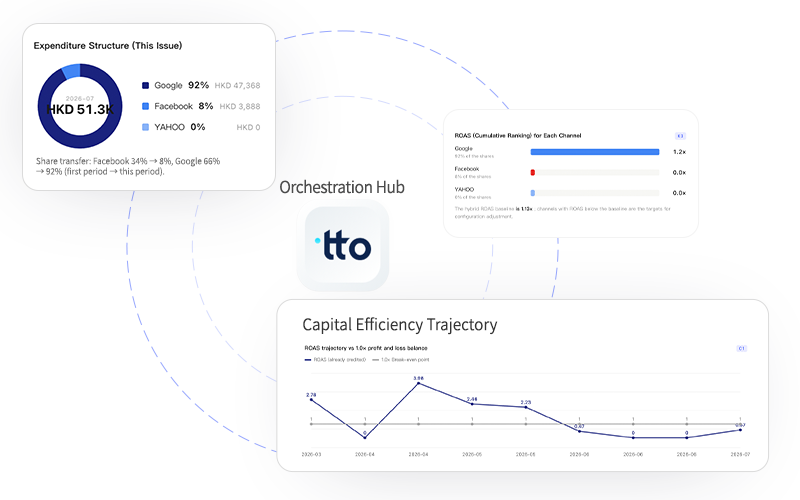
Boundary ①: Cross-platform budget split
No proprietary platform algorithm is capable of concurrent budget optimisation across different ad platforms
Meta automated budget settings are limited to its campaign tier, relying exclusively on its in-house bidding framework. Google Smart Bidding distributes traffic only within its own system. Platform algorithms cannot determine budget weighting between Platform A and Platform B for the month. Cross-channel budget adjustments have to be managed externally.
Boundary ②: Conversion Postbacks & Attribution Windows
End conversions may be relayed, yet attribution windows are subject to limitations
Both platforms accept CRM backend conversion data for algorithm training but enforce rigid time limits. Conversions outside official attribution windows (Meta: 7 days / Google: 30 days) are rejected. B2B orders and long decision-cycle transactions cannot feed into platform models, whereas TTO supports full-cycle funnel analysis covering all such conversions.
Boundary ③: Blind Spots Beyond the Account
Fund wastage frequently arises at touchpoints platforms cannot observe or govern
Ad platform AI's optimisation scope is limited to the ad account. In reality, the funnel from "ad click" to "final deal" includes on-site interactions, form fills, lead progression and CRM follow-up. Platform reports miss these stages, where actual budget bottlenecks often occur.
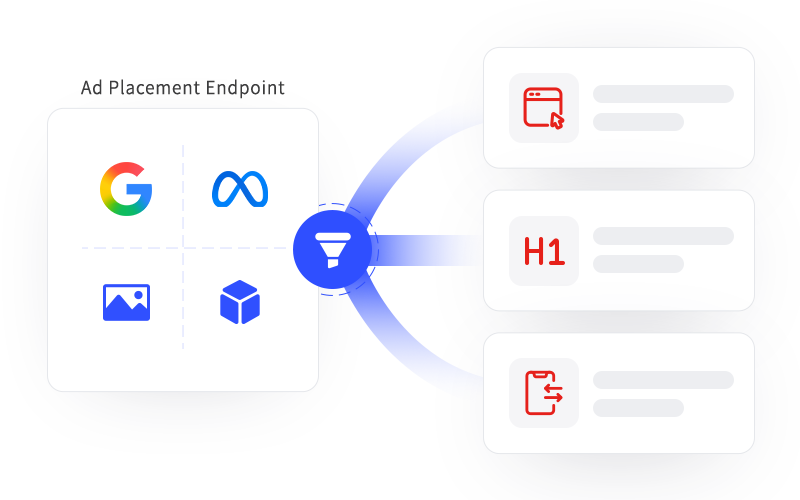
Focus · Out-of-Account Actions
Surpass account boundaries: key actions can only be identified externally to ad platforms
The TTO Agent action list goes beyond bidding tweaks and creative updates. It crosses ad account boundaries: fixing traffic-receiving landing pages, cutting form drop-offs, and highlighting CRM lead follow-up timings & allocation rules. Viewing the complete business funnel as one whole, it leverages cyclic optimisation and accumulated insights to turn out-of-account bottlenecks into concrete optimisation actions, driving continuous performance loop growth across the marketing funnel.
Long-Lasting Agent Architecture, Not Just Reporting
Standard reports have no persistence after execution. The TTO Agent accumulates long-term memory for every marketing initiative
It is not a static BI dashboard or one-time scheduled script. Every marketing campaign runs as an independent Agent instance with dedicated workspace, historical memory and full lifecycle track record. All engineering features below are validated via system logs, not mere rhetoric
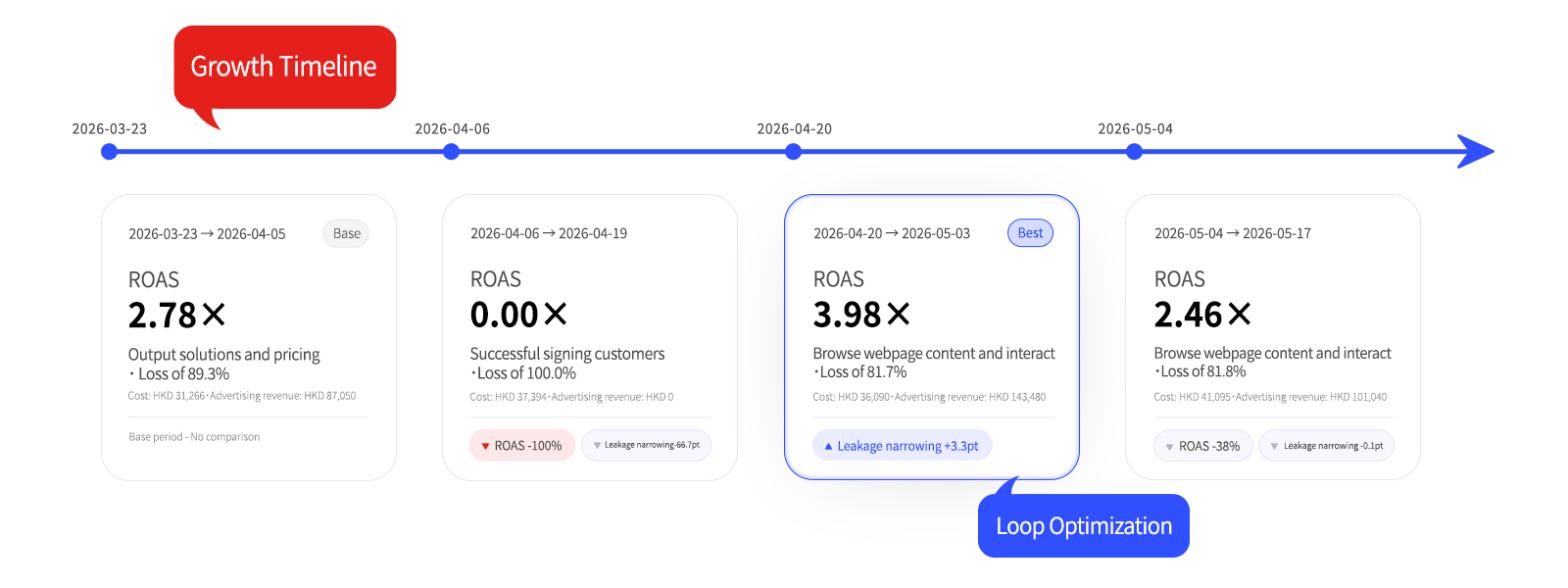
One campaign, one instance. Memory builds across cycles
Each campaign runs as an independent Agent with its own workspace and memory file, preventing context contamination. The system, proven in Topkee projects across Hong Kong, Singapore, and Los Angeles, operates continuously. It doesn't "start fresh" each time but progresses with prior attribution judgments and optimisation decisions.
Cross-Cycle Memory
Extended Deep Analysis with Instant Breakpoint Resumption
Live full-funnel diagnostics range from 14 minutes to 1 hour 27 minutes. Powered by the robust Stall Resumption Guardian, the system avoids random restarts during stalls or timeouts and resumes accurately from breakpoints. Reliably completing long-duration tasks without unnecessary restarts is the core engineering hurdle.
Stall Recovery Guardian
Auditable, Traceable, Seamless Upgrades
Real-time log access allows manual terminal takeover on demand, with support for version upgrades and rollbacks. All command outcomes (success, timeout, failure) are permanently logged. Reliable maintainability relies on transparent logging of faults and timeouts. Iterations to optimisation methodologies take effect across all instances via directory updates, leaving each account’s local memory untouched.
Rollback & Live Methodology Updates
Q&A
Key Considerations Prior to Delegation
For AI tools accessing ad accounts and commercial data, two critical questions stand out: Is data secure? Who takes responsibility if issues arise? All explanations below are based on TTO Agent’s native architecture and service scope, covering functions we will not perform and inherent system limitations
Can it adjust my ad account without prior approval?
No automated changes occur by default.
All action prescriptions arrive marked “Pending Confirmation” until you grant automated execution access. Via the console, you can choose to auto-execute, assign to Topkee, monitor or archive each recommendation.
Upon report delivery, the Agent carries out no automatic actions — every measure requires your authorisation. This core security rule exists at the foundational level, not added as an afterthought. Scope of AI automation and permission revocation mechanisms are defined upfront and strictly managed.
All action prescriptions arrive marked “Pending Confirmation” until you grant automated execution access. Via the console, you can choose to auto-execute, assign to Topkee, monitor or archive each recommendation.
Upon report delivery, the Agent carries out no automatic actions — every measure requires your authorisation. This core security rule exists at the foundational level, not added as an afterthought. Scope of AI automation and permission revocation mechanisms are defined upfront and strictly managed.
How reliable are its assessments? Will it skew reports for better appearances?
It identifies client-side and shared execution issues openly instead of blaming weak market trends.
Reports adopt a conclusion-first format with transparent raw data. Root causes of unmet ROAS, overspend risks, conversion bottlenecks and spend without data feedback are listed objectively. Tools built to manipulate metrics for renewals do not operate in this way.
Instead of merely cutting budgets, it protects undervalued assets. Example: Some keywords show no Quality Score on Google due to limited data but deliver backend conversions. Following official rules that Quality Score is not a KPI or bidding signal, the Agent avoids reckless pausing.
A four-step validation logic (Metric – Judgement – Weighting – Action) is attached to all reports. Every recommendation links directly to target objects, spend and attribution records. Proof is documented, not relayed verbally.
Reports adopt a conclusion-first format with transparent raw data. Root causes of unmet ROAS, overspend risks, conversion bottlenecks and spend without data feedback are listed objectively. Tools built to manipulate metrics for renewals do not operate in this way.
Instead of merely cutting budgets, it protects undervalued assets. Example: Some keywords show no Quality Score on Google due to limited data but deliver backend conversions. Following official rules that Quality Score is not a KPI or bidding signal, the Agent avoids reckless pausing.
A four-step validation logic (Metric – Judgement – Weighting – Action) is attached to all reports. Every recommendation links directly to target objects, spend and attribution records. Proof is documented, not relayed verbally.
How soon will reports and optimisation impacts be visible?
We make no fixed promises of percentage or multiplier gains within a set timeframe. Delivery schedules and processing durations are definitive.
Diagnostics are ready after data onboarding, completion of the initial analysis cycle and closure of the end conversion postback window.
One full-funnel analysis runs for 14 minutes to 1.5 hours; full report generation takes an extra 40 seconds to 2 hours, with no template-driven superficial outputs.
Reports state next-cycle expected ranges and dependencies for follow-up reconciliation. Verifiable forecasts outweigh appealing, unfulfillable commitments.
The system runs continuously. Diagnostic tasks are scheduled via the console to fit your marketing rhythm, with flexible custom timing available.
Diagnostics are ready after data onboarding, completion of the initial analysis cycle and closure of the end conversion postback window.
One full-funnel analysis runs for 14 minutes to 1.5 hours; full report generation takes an extra 40 seconds to 2 hours, with no template-driven superficial outputs.
Reports state next-cycle expected ranges and dependencies for follow-up reconciliation. Verifiable forecasts outweigh appealing, unfulfillable commitments.
The system runs continuously. Diagnostic tasks are scheduled via the console to fit your marketing rhythm, with flexible custom timing available.
Is my data protected? How are account permissions managed?
All ad accounts and data assets remain your sole property.
Sandbox Isolation: Every campaign is a separate Agent instance with dedicated workspace and sessions, fully isolated from one another.
Auditable & Controllable: Real-time logs and anti-duplicate command controls are in place. All timeout and failure events are permanently logged. Agent rollback is supported, and terminal access can be enabled for manual audits.
Model Agility: Multiple providers and fallback routes can be set up. No Agent reconfiguration is needed when updating underlying models.
Data handling, deployment modes and compliance terms are defined in advance. Built-in audit capability is fundamental — not an optional extra — before any operational authority is delegated.
Sandbox Isolation: Every campaign is a separate Agent instance with dedicated workspace and sessions, fully isolated from one another.
Auditable & Controllable: Real-time logs and anti-duplicate command controls are in place. All timeout and failure events are permanently logged. Agent rollback is supported, and terminal access can be enabled for manual audits.
Model Agility: Multiple providers and fallback routes can be set up. No Agent reconfiguration is needed when updating underlying models.
Data handling, deployment modes and compliance terms are defined in advance. Built-in audit capability is fundamental — not an optional extra — before any operational authority is delegated.
What support do we need to provide?
Three requirements, with no upfront changes needed to your ad settings.
① Data Onboarding: Integrate ad accounts, on-site activity and conversion feedback including call tracking, web & lead forms, and CRM deal statuses. Broader data coverage enables deeper funnel visibility. The system never fabricates insights for unavailable data.
② Set your funnel endpoint: Define your business-specific conversion milestone starting from impressions. Funnel structures in practice vary between five and seven stages. Brand initiatives target member interaction, appointment campaigns focus on confirmed bookings, e-commerce tracks purchases, and lead-based businesses prioritise qualified leads. A standardised value for a qualified lead is essential; otherwise cross-platform ROAS benchmarking serves no purpose.
③ Schedule periodic checklist reviews: approve, allocate or archive recommendations in P0 priority order. This process is frequently overlooked. The Agent accumulates knowledge from your judgements — lacking your input, it has fewer data points for subsequent cycles.
Important advance note: The first batch of actions mostly focus on data rectification. Coordination from your technical or website team will be necessary, with workload varying according to the number of issues requiring fixes.
Is there a risk of clashes with your agency, internal team or platform-native automation?
No conflicts arise due to distinct functional tiers, and the Agent never claims exclusive execution rights.
For teams: It handles repetitive, hard-to-maintain bulk verification and granular calculations, letting people focus on strategic decisions covering creatives, total budgets and landing page updates. The action checklist acts as a task roster: work requiring expertise can be routed to Topkee specialists, your internal staff or external agencies. You control task assignment.
For ad platforms: Native automation optimises bids and spending within its own inventory. The Funnel Tuning Agent covers out-of-scope work: cross-platform budget split, mid/late funnel leakage analysis and website optimisation recommendations. We do not recommend turning off platform automation — we help supply higher-quality conversion signals to improve its performance.
For teams: It handles repetitive, hard-to-maintain bulk verification and granular calculations, letting people focus on strategic decisions covering creatives, total budgets and landing page updates. The action checklist acts as a task roster: work requiring expertise can be routed to Topkee specialists, your internal staff or external agencies. You control task assignment.
For ad platforms: Native automation optimises bids and spending within its own inventory. The Funnel Tuning Agent covers out-of-scope work: cross-platform budget split, mid/late funnel leakage analysis and website optimisation recommendations. We do not recommend turning off platform automation — we help supply higher-quality conversion signals to improve its performance.
Assess Diagnostics Before Setting Access Rights
One Cycle Trial: See What It Reveals For Your Business
Link your current data sources and run a full analysis cycle to receive a tiered action checklist open to line-item follow-ups.
Based on available integrated data, it pinpoints funnel leakage layers, root causes and key focus areas for the upcoming cycle. All findings are delivered transparently, including issues originating internally or within landing pages.
You have complete control over implementation decisions and task ownership.
Based on available integrated data, it pinpoints funnel leakage layers, root causes and key focus areas for the upcoming cycle. All findings are delivered transparently, including issues originating internally or within landing pages.
You have complete control over implementation decisions and task ownership.
Diagnostics begin by aligning funnel definitions and data sources; no pre-emptive changes to your ad settings are needed.

Topkee: Technology - Driven Marketing
Services
Products
© 2011–2026 Topkee Media. All rights reserved.